
- Services
Aerial image data
Energy & Climate Analyses
- Industry solutions
- Technology
- Company
- References
- News
- Contact
4,500 liters of water loss. Every day. No visible leak. No signs on the surface.
This was precisely the challenge a local heating cooperative from Ober Kostenz faced when contacting GeoFly in the spring. The situation was critical: despite the enormous water loss, the source could not be located. At the same time, swift action was needed to prevent further damage and costs.
What initially seemed like a challenging isolated case developed into a project of far-reaching importance for us. The successful leak detection not only confirms new technical possibilities for investigating small heating networks, but also forms the basis for an innovation that will allow thermal network testing to be carried out much more flexibly in the future.
When classical methods reach their limits:
The initial situation was exceptional in several respects.
The district heating network was relatively small. A thermal aerial survey would have been neither economically nor technically feasible for a network of this size. Furthermore, we received the request in May, a time when thermal network inspections are typically limited due to rising outside temperatures.
Another unusual circumstance arose: With a water loss of around 4,500 liters per day at a single location, one would often expect to see a visible leak. However, nothing was visible on the surface.
A different approach was therefore needed.
Thermal drone instead of airplane.
This is exactly where our newly established thermal drone operation came into play.
It makes it possible to conduct economical and flexible thermal investigations of even smaller local and district heating networks – wherever aerial surveys have not previously been a practical solution.
Once we had all the necessary input data, we were able to carry out the operation within just two weeks. The flight itself was completed within a few hours.
The decisive factor: our new analysis workflow.
The real challenge only began after the flight.
Due to the already summery conditions, it was by no means certain whether the thermal anomalies would still be clearly recognizable.
This is exactly where our new analysis workflow paid off.
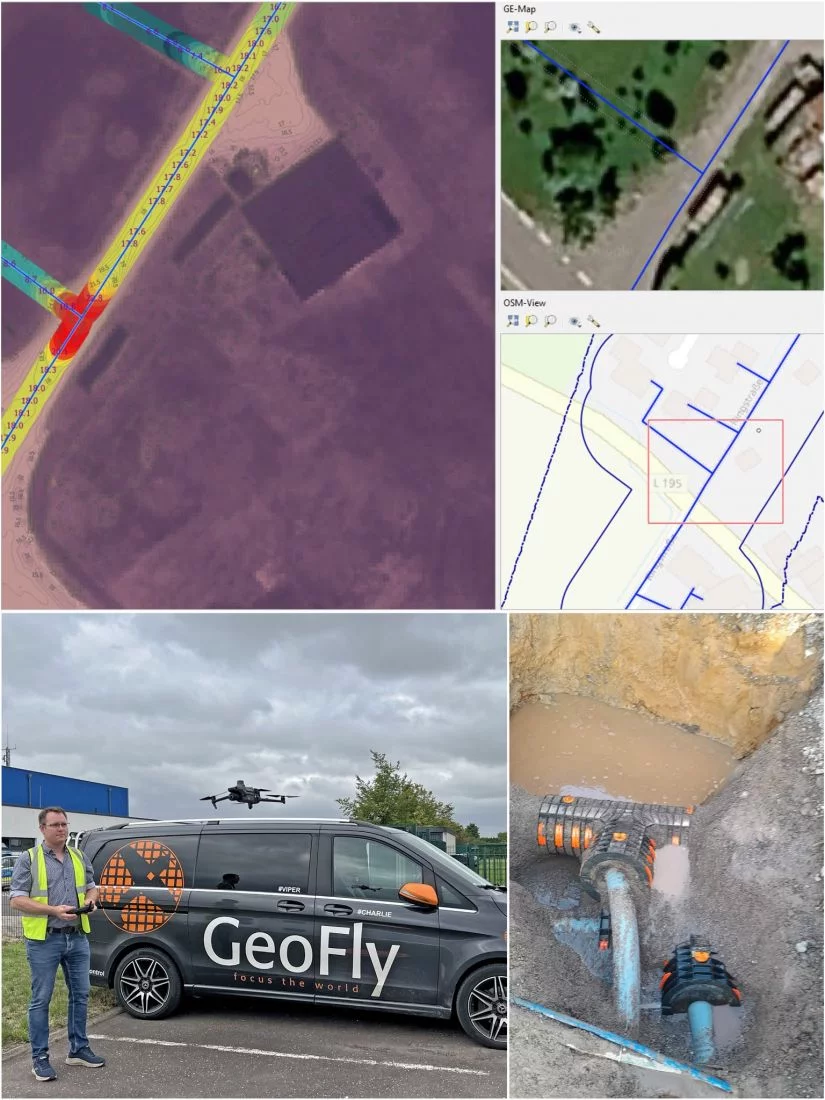
It enables significantly more efficient processing of thermal drone data and delivers much more meaningful results than before. This allowed us to identify a specific suspected location despite the challenging conditions.
We presented our results to the operator directly on site.
Then, an excavation was carried out at precisely this spot.
Successfully. The leak was located exactly where our analysis had pinpointed it.
For the operator, this meant a significant saving in time and costs, as it was no longer necessary to carry out costly exploratory excavations.
More than a successful customer project:
For GeoFly, the project does not end with the discovery of the leak.
The deployment in Ober Kostenz confirms for the first time in a real-world customer project that our production pipeline functions reliably even with thermal drone data. This will allow for the cost-effective analysis of smaller local and district heating networks in the future, a market segment that has previously often only benefited to a limited extent from thermal network testing.
Furthermore, our analytical approach opens up new possibilities for network operators who already have their own thermal drones or have them collecting relevant data. This data can also be integrated into our analysis, further reducing the effort and costs of an investigation.
The next step: the analysis of daily patterns.
The successful deployment in Ober Kostenz simultaneously formed the basis for the next development step at GeoFly.
In addition to our new analysis workflow, we have developed the diurnal analysis , an independent methodology that further expands the possibilities of thermal network analyses.
It is important to distinguish between the two: The new analysis workflow was the foundation for the success of this project. The daily pattern analysis builds on this and opens up additional possibilities.
While traditional analyses consider a single thermal snapshot, diurnal analysis examines the changes in thermal signatures throughout the day, differentiating between various surface types (asphalt, sand, etc.) and within the context of the surrounding environment. This allows for significantly more reliable conclusions to be drawn under suitable conditions, even at summer temperatures.
The benefits extend beyond leak detection. In the future, this methodology could also be used to more reliably identify insulation damage or other thermal anomalies in heating networks.
Above all, the analysis of daily cycles significantly expands the previously very narrow time window for thermal network inspections. Inspections will no longer have to take place exclusively during the traditional thermography season. This is a crucial advantage, especially in cases of acute damage, as water losses don't adhere to the calendar.
With this methodology, GeoFly positions itself as one of the technological pioneers in the field of thermal network analysis and creates new opportunities for network operators to monitor their infrastructure more economically, flexibly and in a future-proof manner.
Would you like to know what possibilities your district heating network offers?
Whether it's a small local heating network, a large district heating network, or existing thermal drone images – we will work with you to determine which approach offers the greatest added value for your network, both technically and economically.
Contact us. Together we will find the right solution for your heating network – precise, efficient and using state-of-the-art thermal analysis technology.
geofly © All rights reserved.