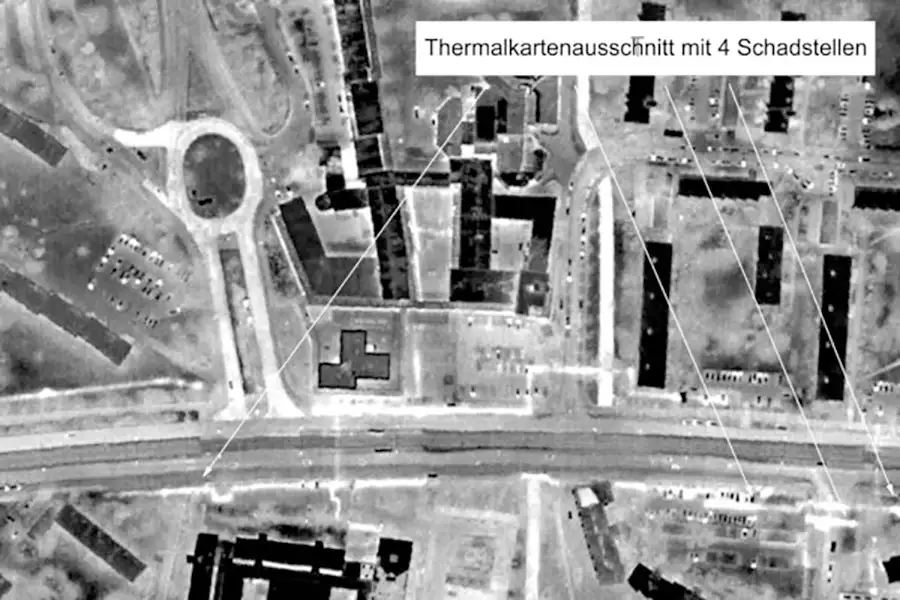
Aerial survey of above-ground and underground district heating pipes to identify damage points
Reliability, security of supply, cost-effectiveness, ease of maintenance, and effective environmental protection are just some of the advantages of district heating, an increasingly important component in complex energy management systems. Insulation damage to district heating pipes leads to high heat losses, premature aging of the pipes, and increased corrosion. Leaks result in operational disruptions and economic losses.
Using high-performance infrared sensors for aerial condition analysis of district heating networks, we provide utility companies with a detailed overview of the overall condition of the pipe network and ensure the precise location of defects. Energy-saving potential and water losses are georeferenced using scaled thermal mapping, visualized with high geographical precision, and evaluated.
When detecting damage to district heating pipes, surface temperatures are measured to an accuracy of one-tenth of a degree. This allows for the precise detection of any damage to a pipe.
In Leipzig, the thermographic aerial survey provided important data on the condition of the district heating network and helped to detect energy losses early.