urban climate

Advantages

  • Scientifically sound data for urban climate and climate adaptation strategies
  • accurate recording of urban temperature differences and their effects
  • Support in the planning of climate-adapted neighborhoods and green spaces
  • Can be combined with meteorological and air quality measurements for a comprehensive picture

Applications

  • Thermographic mapping of overheated areas in cities
  • Visualization and integration into urban and construction planning
  • Large-scale representation of surface radiation temperatures for a current climatic situation
  • Thermographic flights conducted at different times (e.g., morning/evening) to determine dynamic climate processes
urban climate


Precise geodata for your project?


Contact us – we will advise you individually and develop the right solution.
Inquire now.

TÜV ProfiCert

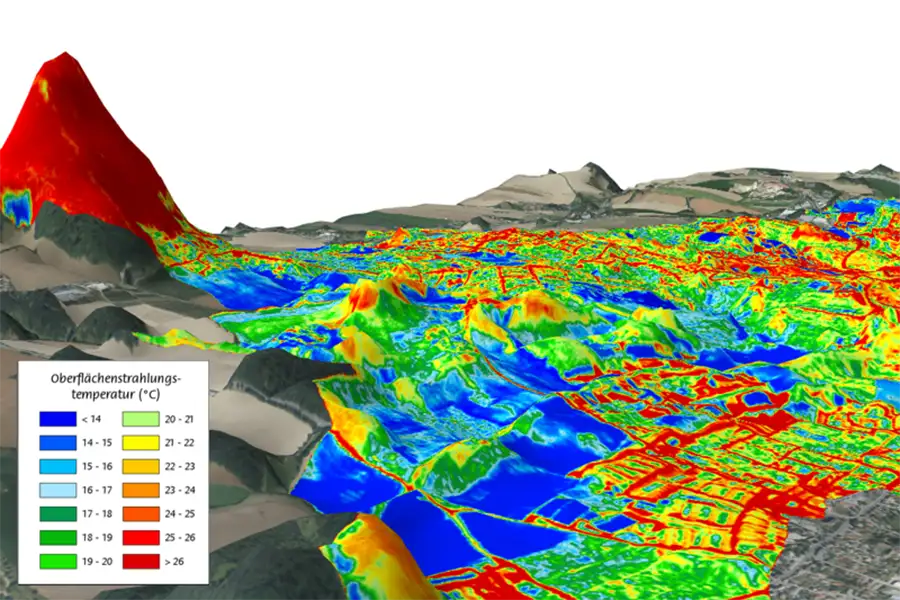
Thermographic survey of urban areas to identify overheating zones

GeoFly GmbH uses airborne thermography to map and analyze large areas in urban environments. A key objective is to visualize urban heat islands and cold air corridors and incorporate this information into urban planning decision-making processes. With increasingly intense heat waves, this is a crucial tool for cities' climate adaptation strategies.

The most well-known phenomena of urban climate are urban heat islands, characterized by large temperature differences within built-up areas and their surrounding areas. Urban growth leads to changes in wind patterns, air quality, and ventilation. In conjunction with meteorological and air quality measurements, aerial thermographic surveys, due to their comprehensive representation of surface radiation temperatures, provide the most important basis for understanding the current climatic situation. Aerial surveys of urban climate should include at least two different recording times (e.g., evening and morning). This results in classified thermal maps of surface temperature behavior, which demonstrate a close relationship between areas of warming and cold air within the urban microclimate.

Our references

Selected examples of our work

City of Dingolfing

For the city of Dingolfing, heat islands and cold air corridors were made visible by means of thermographic aerial surveys.

City of Regensburg

For the city of Regensburg, the thermographic aerial survey provided important insights into the urban climate and made heat islands visible.