Airborne laser scanning

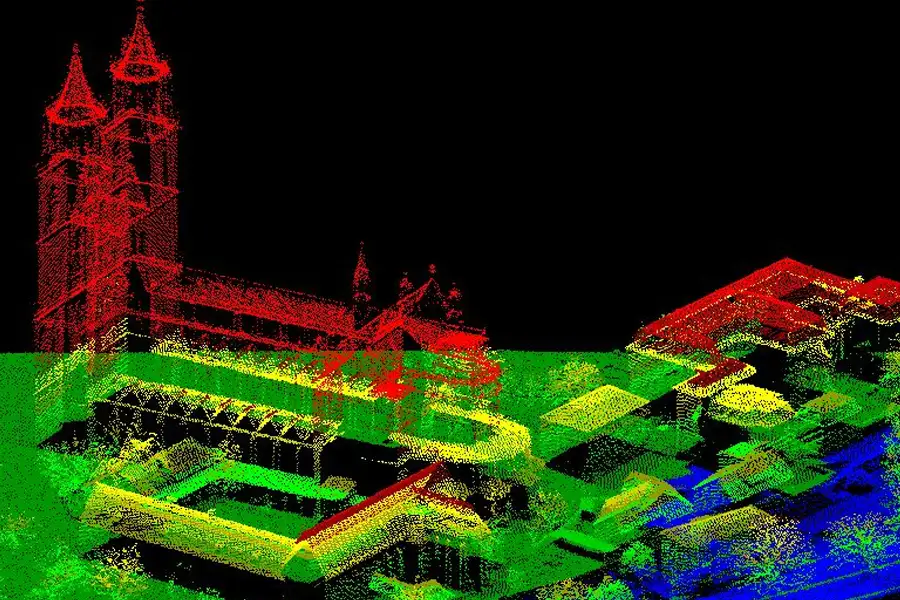
Airborne laser scanning precisely captures the Earth's surface using laser beams. This technology enables highly detailed surface models and terrain data.

Overview of laser scanning services

  • Planning and execution of aerial surveys using laser scanners
  • Combination with a large-format photogrammetric camera for synchronous flight is possible
  • Categorization into a multitude of classes 
  • Topographic evaluation of the classified point cloud

Applications of laser scanning

  • Creation of digital surface models
  • Derivation of digital terrain models
  • Creation of digital vegetation height models
  • Integration into 3D meshes is possible
Airborne laser scanning


Precise geodata for your project?


Contact us – we will advise you individually and develop the right solution.
Inquire now.

TÜV ProfiCert

Laser scan (LiDAR) in detail

Unlike photogrammetry, laser scanning is not an imaging technique, but rather a laser-assisted point measurement process. These point measurements are performed at very high speeds, creating a dense, three-dimensional network of measurement points across the Earth's surface. With current technology, up to 2.5 million points per second can be measured. Depending on the flight speed and altitude, measurement point networks with a density of up to 60 points per square meter can be generated. Under suitable conditions, measurement accuracies of up to 5 cm can be achieved.

LiDAR surveying can be combined with other sensors to create an expanded product. Possible combinations include:
  • LiDAR aerial imaging
  • LiDAR – Thermal
  • LIDAR – Hyperspectral
The individual products are georeferenced together, thus forming a homogeneous database for the respective use case.

GeoFly primarily uses LiDAR systems from the company Riegl.

Our references

Selected examples of our work

LAIV Mecklenburg-Vorpommern

From November 2020 to March 2021, we recorded 3,260 km² for LAIV Mecklenburg-Vorpommern using laser scanning with 5 points/m².

State Office for Surveying and Geoinformation Saxony-Anhalt

In February 2024, we recorded 543 km² for the LVermGeo Saxony-Anhalt using laser scanning with 4 points/m².

Trigis GeoServices

From February to April 2024, we recorded 283 km of track with a width of 1 km for Trigis GeoServices using laser scanning with 20 points/m².